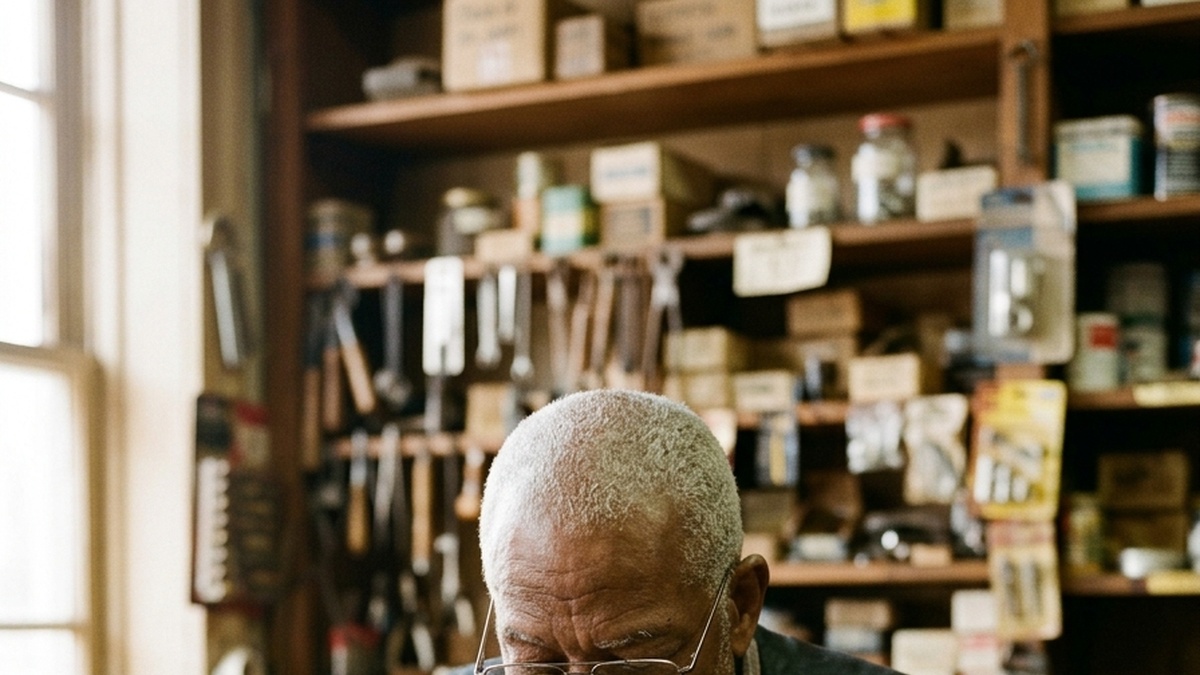
The young woman slid the ring across Odell Harper's glass counter and asked what he would loan her on it, and Odell knew before he touched it that he had made it himself.
He did not let it show. He had been behind that counter for forty-eight years, and he had learned to keep his face as still as a pond.
"Let's have a look," he said.
He picked it up with two fingers and turned it toward the light from the front window. A plain gold band, worn thin on the palm side the way rings get after a lifetime of dishes and garden dirt. One small diamond chip in a raised setting. Inside the band, in script letters gone soft with age, an inscription.
O.H. to R.M. 1968.
Odell reached for his loupe.
Harper's Hardware and Loan sat where the county road crossed the state highway at Ellery Crossroads, Georgia. Odell's father had opened it in 1956. Out front were the gas pump and the bench where the old men sat. Inside were nails by the pound, peanut seed in season, fishing tackle, and, behind the glass case by the register, the pawn counter.
In a farm county, a pawn counter was a kind of bank for people the bank did not want. Odell had loaned money on shotguns, chainsaws, wedding rings, and once on a mule. He was fair about it. Most folks came back for their things.
Before any of that, he had been a jeweler's apprentice in Albany for two years, at an old shop where a German watchmaker taught him to engrave. Every piece Odell ever engraved, he signed the same way. A tiny five-point star, no bigger than a grain of sand, cut inside the band just after the last letter.
He set the loupe to his eye.
There it was. His star.
There was something else, too. Next to it, faint and crooked, were a few small scratches in the gold. Someone had worried at the inside of the band with a pin, the way some people do when they are sitting in a waiting room or a church pew. Odell noticed it and set it aside in his mind.
"It's my grandmother's," the young woman said. "She said I could."
Her name was Kayla Toomer. She was twenty-four, in blue scrubs with a hospital badge clipped to the pocket. She worked as an aide at the nursing home in Albany, thirty miles away. Her transmission had gone out on Monday. The repair was eleven hundred dollars, and if she couldn't get to work by Saturday, she would lose her job.
"I've got eight hundred saved," she said. "I just need three."
Odell looked at her face. He knew that face. He had not seen it in fifty-six years, but he knew it.
"Your grandmother," he said carefully. "What's her name?"
"Ruby. Ruby Toomer. Her name was Mathis before she married my granddaddy." Kayla smiled a little. "She lives at the home where I work. That's how I got the job."
The bell over the door rang. Odell's nephew Mitch came in from the back lot with a cardboard box in his arms.
Mitch was forty-five and ran the store's books now. He was a good man and a worried one. The property taxes were due December first, the store was nine thousand dollars short, and gold was selling for more than Mitch had ever seen.
"Uncle Odell, the refiner from Macon comes Friday," he said. He set the box on the counter. It held thirty years of unclaimed pawn jewelry, chains and class rings and broken watches. "This box is going to pay the tax bill." He glanced at the ring under Odell's hand. "Is that a buy?"
"It's a loan," Odell said.
"Gold's high right now. If she wants to sell it outright, we could..."
"It's a loan, Mitch."
Mitch knew that tone. He took his box to the back.
Odell wrote out a pawn ticket for three hundred dollars and counted the money into Kayla's hand. He put the ring in a small paper envelope with her name on it. He did not put it in the case. He put it in his shirt pocket.
"Ninety days," he said. "And Miss Toomer, there's no rush."
He sat on the front bench that evening after the store closed. The cotton modules stood wrapped in yellow plastic in the field across the highway, waiting for the gin trucks. The sky over the pecan trees went orange, then purple.
He had made that ring in the spring of 1968. Three nights at the bench after the shop closed, with the German watching over his shoulder. He had given it to Ruby Mathis on the steps of Ellery Baptist Church on a Sunday in June, and she had said yes before he got the whole question out.
He shipped out in August.
In March of 1969, a mortar round hit the bunker next to his. He spent five months in an Army hospital in Japan with his hands bandaged so he couldn't hold a pen, and months more in a hospital stateside. The backs of his hands still shone with the old scars. When he finally came home to Ellery Crossroads in the spring of 1970, Ruby Mathis was Ruby Toomer, married to a peanut farmer's son and expecting their first child.
He had never asked her why. He had seen her at the post office, at funerals, at the Christmas parade. They nodded. That was all. Fifty-six years of nodding.
He never married. People in the county figured he was too particular.
Kayla came back Thursday afternoon. She was not in scrubs this time. Her eyes were red.
"Mr. Harper, I need to ask you something," she said. "And I'm going to pay you back, I promise. But I need the ring back first."
"Is something wrong?"
"Grandma found out where I took it." Kayla wiped her eyes with the back of her hand. "She hasn't cried in front of me since Granddaddy passed. She cried today. She said, 'Not to Harper's. Of all the places in this world, not to Harper's.'"
Odell's hand went still on the counter.
"She told me who gave it to her," Kayla said. "A boy she was going to marry before she met my granddaddy. She said he died in Vietnam. She said he was the kindest boy in this county, and she never stopped being sorry."
The store was very quiet. Somewhere in the back, Mitch had stopped moving boxes.
Odell looked down at his own scarred hands, flat on the glass.
"Miss Toomer," he said, "that boy didn't die."